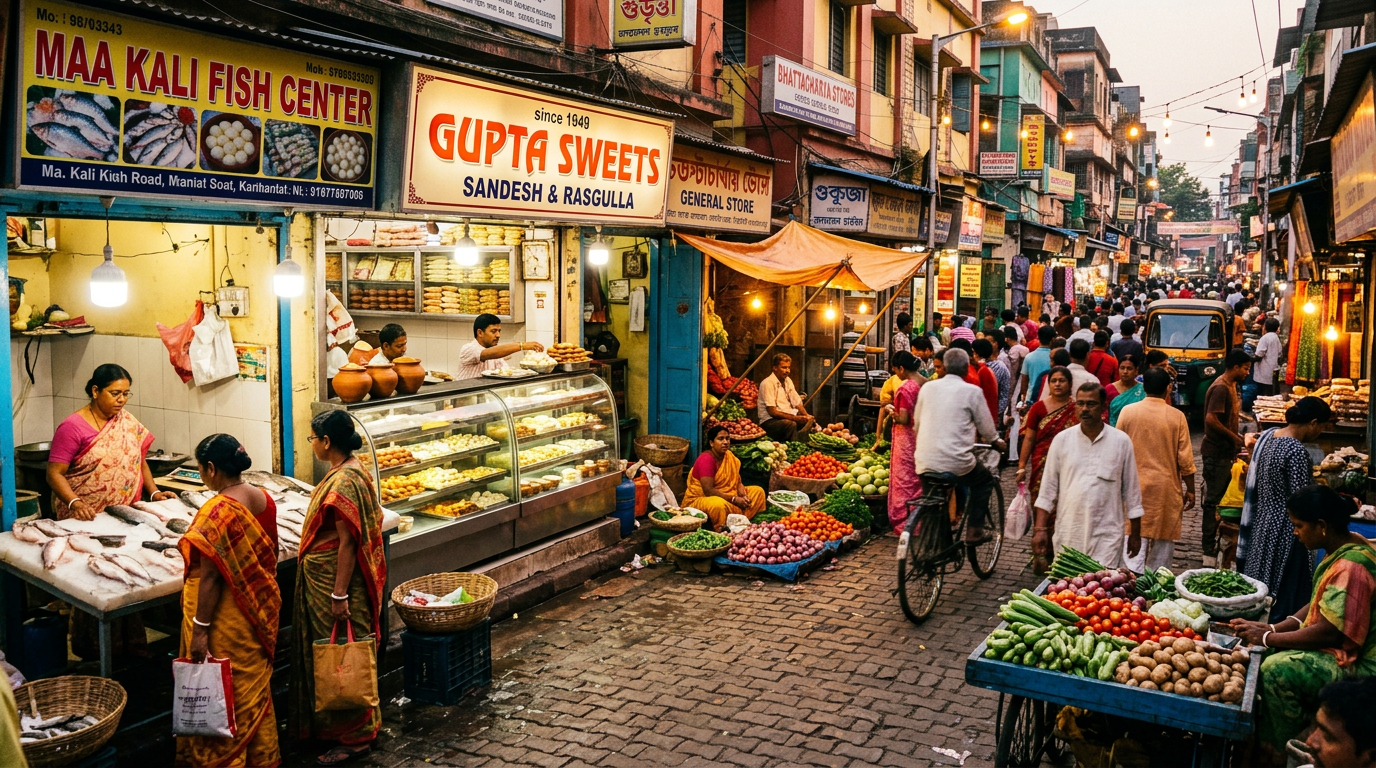
CR Park’s four markets are the commercial backbone of the colony and, for many visitors, the primary reason to come here. These are not malls or sanitized retail spaces — they are bustling, crowded, aromatic neighborhood markets where you can buy fresh Hilsa fish shipped overnight from Kolkata, pick up a jar of authentic Kashundi mustard, argue about the quality of Gobindobhog rice, and eat the best phuchka in Delhi, all within a few hundred meters. The markets serve roughly 78,000 residents daily and attract Bengali food enthusiasts from across the National Capital Region.
This guide is the map: which of the four markets to walk into, and what to carry home from any of them. Each market has its own page with the shop-level detail.
Which Market to Use
The four markets are not four versions of the same thing. Markets 1 and 2 are destinations that pull visitors in from across the NCR; Markets 3 and 4 exist so that residents of the surrounding blocks do not have to walk to them for milk and medicines.
| Market | Its role | Go for | Footfall | Walk from Nehru Enclave metro |
|---|---|---|---|---|
| Market 1 | The flagship | Fish alley, phuchka, cutlets, Kolkata biryani, sweets | Heaviest — the one most visitors mean by “CR Park market” | 12 min |
| Market 2 | The complete market | Sit-down restaurants, sweet shops, the larger fish alley, groceries, banking, electronics | Heavy, but spread over a bigger footprint | 12 min |
| Market 3 | The quiet neighbour | Groceries, pharmacy, tailoring, household goods | Low; the most relaxed of the four | 10 min |
| Market 4 | Last-mile convenience | Grocery store, pharmacy, a few snack counters | Lowest; nearby blocks only | 8 min |
If you have one afternoon, take Market 1 for the street food corridor after 4:00 PM. If you are cooking, take Market 2 — the fish alley is bigger and the grocery shelves are deeper. If you are staying in the colony, you will end up in whichever of Markets 3 or 4 is closest to your block, and that is exactly what they are for.
Market 1 or Market 2?
Markets 1 and 2 are the two worth planning a trip around, and the choice between them comes down to whether you are eating standing up or cooking at home.
Market 1 sits near the Kali Mandir hillock and packs fish, street food, groceries, sweets and general retail into one compact, high-energy space. Its lane turns into a street food corridor after 4:00 PM. Full shop list, prices and fish-buying tips: CR Park Market 1.
Market 2 has the larger footprint and the wider range — restaurants, sweet shops, pharmacies, electronics and banking alongside the food — and the Shani Temple sits directly behind it. Its fish alley runs along the rear of the market as a dedicated zone, with more vendors, more variety and marginally better prices than Market 1’s, which is where serious home cooks and restaurant suppliers buy. Full shop list and restaurant details: CR Park Market 2.
Both alleys are stocked by the same daily overnight shipments from Kolkata and the eastern coast, and both are best visited between 7:00 and 9:00 AM. Choose Market 1 for the spectacle, Market 2 for the selection.
Markets 3 and 4
Market 3 serves the blocks closest to it with daily essentials and has neither the destination-quality fish market nor the famous eateries of its larger siblings. Its lower footfall is the point: residents nearby prefer it for bread, milk, eggs and toiletries without the crowd pressure of Markets 1 and 2. See Market 3.
Market 4 is the smallest of the four, a functional cluster of essential shops at the colony’s periphery rather than a shopping destination. See Market 4.
Neither is worth a detour if you have come to CR Park to eat or to shop for Bengali provisions.
Bengali Specialty Items: What to Buy in CR Park
CR Park’s markets are the go-to source in Delhi for ingredients and products that are staples in Bengali homes but nearly impossible to find elsewhere in the city. A shopping list for the serious Bengali cook or the curious food explorer:
Pantry Essentials
| Item | What It Is | Price Range | Where to Find |
|---|---|---|---|
| Mustard oil (Kachchi Ghani) | The primary cooking fat in Bengali cuisine; pungent, sharp, essential | Rs 150-220/litre | Multiple shops, Markets 1 & 2 |
| Panch Phoron | Five-spice blend (fenugreek, nigella, cumin, black mustard, fennel) | Rs 40-80/100g | Grocery stores, Markets 1 & 2 |
| Posto (Poppy Seeds) | White poppy seeds; ground into paste for Aloo Posto, Posto Bora | Rs 120-180/100g | Grocery stores, Markets 1 & 2 |
| Kasundi | Fermented mustard sauce; Bengali condiment | Rs 60-120/bottle | Grocery stores, Market 2 |
| Gobindobhog Rice | Short-grain aromatic rice; used for payesh (kheer) and special dishes | Rs 100-160/kg | Select grocery stores |
| Nolen Gur (seasonal) | Date palm jaggery; winter-only (Dec-Feb); smoky caramel flavor | Rs 300-600/kg | Sweet shops and grocery stores |
| Shorshe (Yellow Mustard Seeds) | Ground into paste for fish preparations; different from rai | Rs 30-50/100g | All grocery stores |
| Gondhoraj Lebu | Aromatic Bengali lime; intensely fragrant; used in fish and rice | Rs 10-20/piece | Seasonal, select vendors |
Non-Food Bengali Items
- Bengali books and magazines — Bookshops in CR Park stock literature from major Kolkata publishers including Ananda Publishers, Dey’s Publishing, and Mitra & Ghosh. You can find novels by contemporary Bengali authors, classic works, children’s literature in Bengali, and periodicals like Desh and Sananda.
- Second-hand book stalls — Appear periodically near Market 1 and during community book fairs, offering out-of-print Bengali titles at bargain prices.
- Puja supplies — Dhunuchi (incense burners), shankha (conch bangles for married women), alta (red dye for feet), sindoor, specific puja flowers and leaves — all available before major festivals.
- Bengali sarees and clothing — Select shops carry Tant, Jamdani, and Baluchari sarees. While the selection is smaller than Kolkata’s New Market, it is the best in Delhi for authentic Bengali weaves. Prices range from Rs 1,500 for everyday Tant to Rs 15,000+ for fine Jamdani.
Bookshops and Literary Culture
CR Park’s bookshop scene reflects the Bengali community’s deep relationship with literature. Bengalis have historically been among India’s most prolific readers and writers, and this shows in CR Park’s market culture.
What is available:
- Bengali fiction and non-fiction — Novels, short story collections, essays, and poetry from Kolkata’s major publishing houses
- Rabindranath Tagore — Complete works, individual collections, and critical editions are perennial sellers
- Children’s Bengali books — Essential for families raising bilingual children in Delhi
- Little magazines — Small-press literary journals and poetry collections, a vibrant tradition in Bengali literary culture
- English and Hindi titles — General bookshops also stock mainstream English and Hindi publications
The literary culture extends beyond bookshops. CR Park hosts periodic book fairs, poetry readings, and literary discussions, often organized by Bangiya Samaj or block-level cultural committees. These events, typically held in community halls or temple courtyards, feature Bengali authors visiting from Kolkata.
Practical Shopping Tips
Timing:
- Fish market: 7:00-9:00 AM for best selection; by 11:00 AM, the premium catch is gone
- General shopping: 10:00 AM-1:00 PM or 5:00-8:00 PM; avoid the 1:00-4:00 PM lull when many shops close for lunch
- Festival shopping (Durga Puja season): Markets stay open until 10:00-11:00 PM; the best atmosphere, but the biggest crowds
- Weekly off: Most shops close one day per week, but the day varies by shop. There is no colony-wide market closure day.
Payment:
- Cash is still widely used, especially for fish and street food vendors
- A few words of Bengali help at the fish counter; the phrasebook covers the ones vendors actually use
- UPI (PhonePe, Google Pay, Paytm) is accepted at most established shops
- Credit/debit cards are accepted at larger stores but not at smaller vendors
Bargaining:
- Expected at fish markets and some grocery stores
- Fixed prices at sweet shops, branded stores, and pharmacies
- A polite but firm approach works; aggressive bargaining is considered poor form
Parking:
- Extremely limited near Markets 1 and 2. Street parking fills up quickly, especially on weekends.
- During Durga Puja (October), parking near markets is essentially impossible. Walk, take an auto-rickshaw, or use the metro (Nehru Enclave station, 1.1 km).
Hygiene note:
- The fish market areas can be slippery and pungent. Wear shoes you do not mind getting wet. The smell, while strong, is the smell of freshness — not of decay, if you arrive early enough.
For restaurant-specific details, see our Bengali Food & Restaurants Guide. For an overview of CR Park, see the Complete Guide to Chittaranjan Park.
Frequently Asked Questions
Which CR Park market should I visit?
If you have one trip, choose between Market 1 and Market 2. Market 1 is the street food and fish destination — phuchka, cutlets, biryani and the fish alley. Market 2 is the sit-down and stock-up market — Maa Tara, Annapurna Sweets, a larger fish alley, and the widest grocery selection. Markets 3 and 4 are neighbourhood convenience clusters and are not worth a special trip.
What time does CR Park market open?
CR Park markets typically open by 9-10 AM and close by 9 PM. The fish market is best visited in the morning (7-9 AM) for the freshest catch. During festivals, especially Durga Puja, market hours extend late into the night.
Which CR Park market has the better fish alley?
Both Market 1 and Market 2 receive daily shipments from Kolkata and the eastern coast. Market 2's alley is larger and has more vendors competing, so it carries more variety at slightly better prices. Market 1's alley is smaller, and sits beside the lane that becomes a street food corridor in the late afternoon.
What can I buy in CR Park market?
CR Park markets offer Bengali staples not easily found elsewhere in Delhi — fresh river fish (Hilsa, Katla, Rohu), mustard oil, panch phoron (five-spice blend), posto (poppy seeds), Bengali sweets, and specialty items like nolen gur (date palm jaggery) in winter. Plus regular groceries, clothing, electronics, and household items.
Are there bookshops in CR Park?
Yes, CR Park has notable bookshops including shops selling Bengali literature, publications from Ananda Publishers, and second-hand book stalls. The literary culture reflects the Bengali community's deep connection to reading and intellectual discourse.