
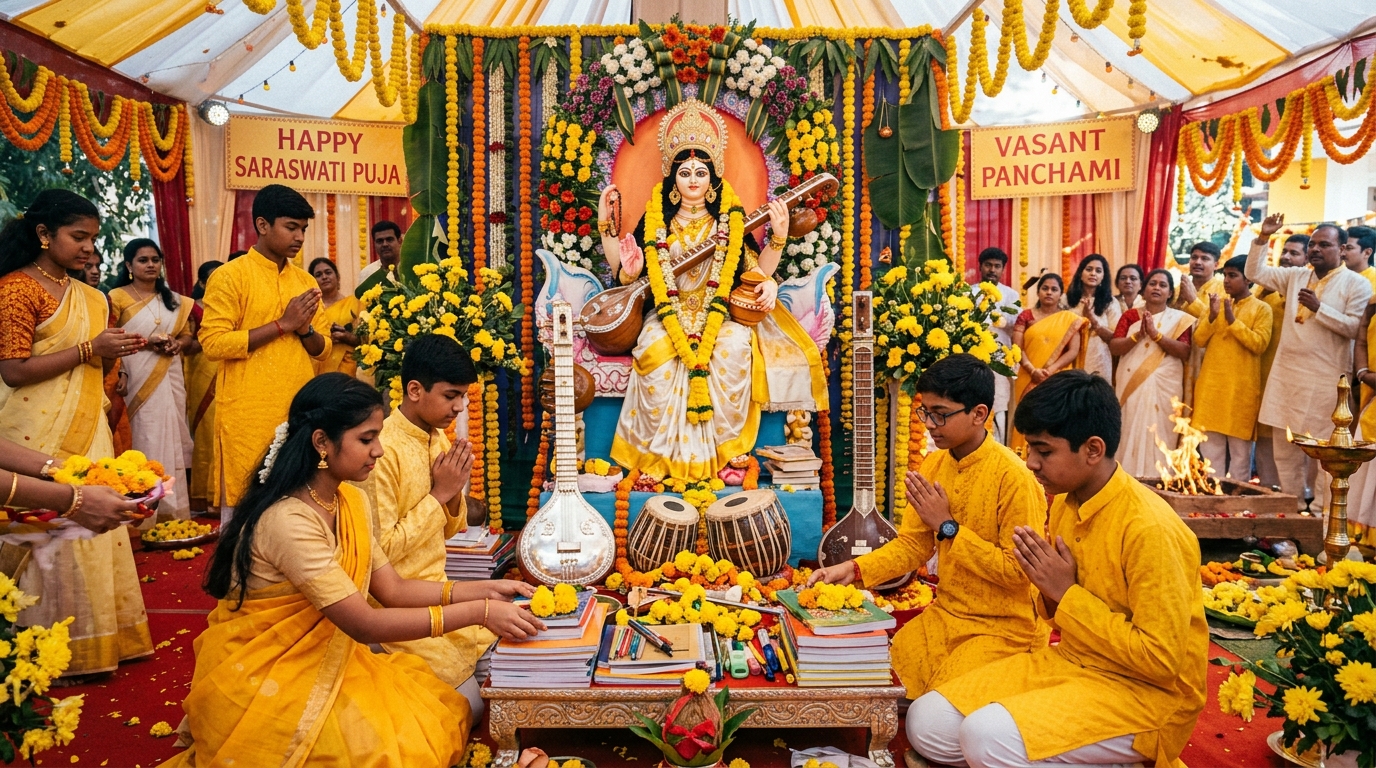
Saraswati Puja on Vasant Panchami is one of the most visually striking days in Chittaranjan Park’s calendar. The colony turns yellow — marigold garlands on doorways, mustard-coloured sarees and kurtas on residents, and freshly decorated Saraswati idols in homes, schools, and the Kali Mandir.
The Celebration
Goddess Saraswati is the Hindu deity of knowledge, music, and the arts. On this day students from across CR Park place their books, pens, and musical instruments at the feet of the idol, seeking blessings for academic success. The main community puja at Kali Mandir draws large morning crowds, with the pushpanjali (floral offering) being the highlight. The muhurat for the 2026 puja is 7:15 AM to 12:50 PM.
What to Expect
Arrive early — by 9:30 AM — to avoid queues at Kali Mandir. The pushpanjali is typically conducted in batches, with priests guiding devotees through the mantras. After the puja, bhog (prasad) of khichuri, begun bhaja, chutney, and payesh is distributed to all attendees.
Homes across CR Park also host private Saraswati Pujas, and you’ll see groups of young people carrying decorated idols through the lanes. Schools in and around CR Park hold their own celebrations, often including essay-writing and drawing competitions themed around knowledge and learning.
Hatekhori — a child’s first letters
Saraswati Puja is the day Bengali families traditionally hold hatekhori, the ceremony that begins a child’s education. A priest or an elder guides the child’s hand to trace the first letters of the Bengali alphabet on a slate, a palm leaf, or a plate of rice placed in front of the idol. The child is usually four or five, the whole thing takes a few minutes, and it is the reason the day carries so much weight for families with small children. For a great many Bengalis, the first thing they ever wrote was written on this morning.
Older students bring what they work with rather than what they read. Musicians place instruments at the goddess’s feet, artists leave brushes and sketchbooks, and in most households the schoolbooks go to the idol in the morning and stay there. Studying on Saraswati Puja is traditionally not done — the books belong to the goddess for the day, which makes it the one date in the calendar when a Bengali student is formally excused from homework.
The bhog, and the rule about kul
The food served after pushpanjali is niramish: cooked without onion or garlic, as all Bengali puja bhog is. The standard set is khichuri, labra, a fried item such as begun bhaja, a tomato-date chutney, and payesh to close. It is distributed free to everyone present, and there is no expectation that a visitor contribute anything to receive it.
Alongside the bhog comes the one food custom that catches visitors out. Kul — the small tart Indian jujube — ripens in the weeks before Vasant Panchami, and Bengali households traditionally do not eat it until it has first been offered to Saraswati. The prohibition is taken seriously enough that children are warned about it, and the first kul of the year is eaten as prasad on this day. Kul chutney and kul-based preparations appear in the bhog for exactly this reason.
After the puja
The idols set up in homes, schools and club rooms are made to be temporary. They are immersed after the puja concludes, usually the following day, and in the hours between the two the atmosphere shifts: the formality of the morning gives way to visiting, with groups of students walking from one household idol to the next to see how each has been decorated. Schools and clubs generally immerse through whatever arrangement their own puja committee has organised.
Practical Tips
- Wear yellow — it’s the colour of the day and you’ll feel part of the celebration
- Reach Kali Mandir by 9:30 AM for a comfortable pushpanjali experience
- Bhog is free — served after the main puja concludes around 1 PM
- Photography — permitted in the temple courtyard; be respectful during active worship
Frequently Asked Questions
What time is Saraswati Puja at Kali Mandir in 2026?
The puja muhurat at Kali Mandir runs from approximately 7:15 AM to 12:50 PM on January 23, 2026. The main pushpanjali (floral offering) usually takes place between 10:00 AM and 11:00 AM.
Why do people wear yellow on Saraswati Puja?
Yellow represents the mustard flowers that bloom in spring (Vasant) and symbolises knowledge and wisdom. Wearing yellow on Vasant Panchami is a Bengali tradition honouring both the season and Goddess Saraswati.
Can non-Bengalis participate in the Saraswati Puja?
Absolutely. The puja at Kali Mandir is open to everyone. Visitors are welcome to offer pushpanjali and receive prasad. Wearing yellow or light-coloured clothing is appreciated but not required.