
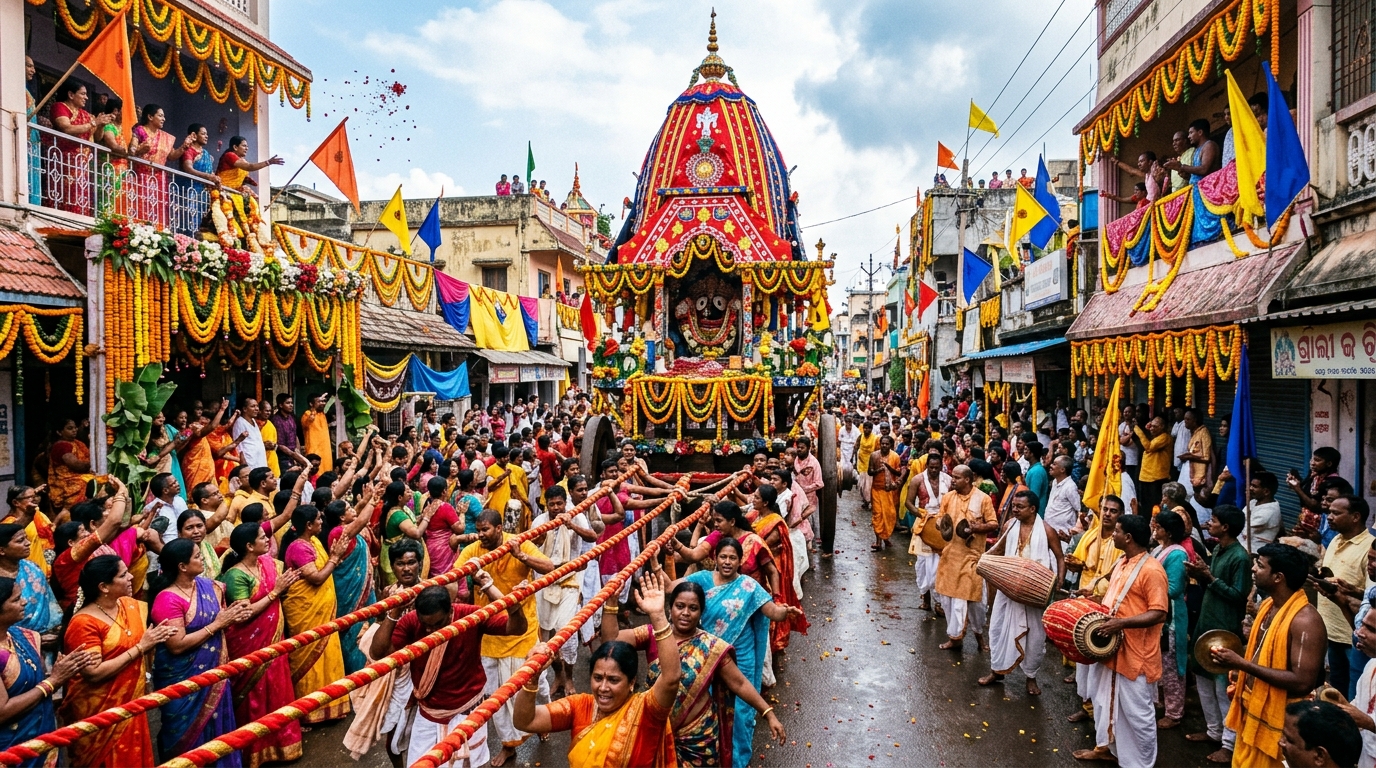
Rath Yatra — the Festival of Chariots — is observed at the Radha Krishna temple within CR Park’s Kali Mandir complex every year on the second day of Shukla Paksha in the month of Ashadha. In 2026 it falls on July 16.
The Observance
Unlike the massive Rath Yatra processions of Puri or Kolkata, CR Park’s celebration is a community-scale devotional event. The morning begins with a special puja dedicated to Lord Jagannath, Subhadra, and Balabhadra. Priests conduct the rituals while devotees gather in the temple courtyard for bhajan and kirtan — devotional songs accompanied by harmonium and tabla.
Procession and Prasad
In some years a small decorated rath (chariot) is pulled through the nearby lanes of CR Park by devotees, recreating the spirit of the Puri Rath Yatra on a neighbourhood scale. The procession is accompanied by chanting and the sound of conch shells. After the puja and procession, prasad — typically khichuri and sweets — is distributed to all attendees.
The three figures on the chariot
Rath Yatra is unusual among Hindu festivals in that its deities do not look like anyone else’s. Jagannath, his elder brother Balabhadra and their sister Subhadra are carved from wood in a deliberately unfinished form — no hands beyond stumps, no legs, enormous circular eyes, a broad flat face. The images are repainted and, at long intervals, remade entirely, which makes them a rare case of deliberately impermanent sculpture in a tradition that generally works in stone and metal.
The three are placed on chariots and pulled, and the whole theology of the festival is contained in that act: the deity leaves the sanctum and comes out onto the road, where anyone can approach without entering a temple at all. It is the one day in the year when the usual hierarchy of access is set aside.
Ulto Rath — the return journey
The festival has two halves. The outward procession takes the deities to a second location; Ulto Rath, eight days later, brings them back. Bengali households mark the return as its own small occasion, and in many families the papier-mache or wooden toy chariots that children pull around the neighbourhood are put away only after Ulto Rath rather than on the first day.
The interval between the two is traditionally regarded as an auspicious stretch, and in Bengal the start of Rath Yatra is also the customary date on which work begins on the Durga idols for the autumn — the bamboo frames are commissioned and the first clay is applied around now, three months before the pandals go up. The Durga Puja guide covers what that eventually produces.
Jagannath in Bengali practice
Though the best-known Rath Yatra is Odia, the observance has deep roots in Bengal through the Gaudiya Vaishnav tradition, which holds Jagannath in particular reverence; Chaitanya Mahaprabhu, the sixteenth-century Bengali saint at the centre of that tradition, spent much of his later life at Puri. Bengal keeps its own long-established rath yatras, of which the fair at Mahesh in Serampore is the most famous.
Prasad and the rain
The prasad distributed after the puja is niramish — khichuri, a vegetable preparation, and sweets. In Bengal the day is also associated with papad and jilipi sold at the roadside fairs that grow up around the procession route.
One practical consequence of the timing: Ashar falls squarely in the monsoon, and Rath Yatra is reliably a wet festival. Bengali proverbs about rain on the chariot day exist for a reason, and an umbrella is the single most useful thing to carry.
Practical Tips
- Arrive by 7:00 AM for the main puja; the event concludes by late morning
- Dress modestly as this is a devotional temple event
- July weather — carry an umbrella as this falls during the Delhi monsoon season
- Parking — use the Kali Mandir parking area; the event does not cause major traffic disruption
Frequently Asked Questions
What is Rath Yatra and when is it in 2026?
Rath Yatra (Festival of Chariots) celebrates Lord Jagannath's annual journey. In CR Park it is observed on July 16, 2026, at the Radha Krishna temple within the Kali Mandir complex, with prayers, bhajans, and a small community procession.
What time does the Rath Yatra puja begin?
The morning puja typically starts around 7:00 AM. The procession, if held, usually begins around 9:00 AM after the main prayers conclude. Prasad distribution follows immediately.
Is this a large public event or a temple observance?
CR Park's Rath Yatra is primarily a temple-level devotional observance rather than a large-scale public festival. It is intimate and spiritual, attracting regular devotees and neighbourhood families. All are welcome.