
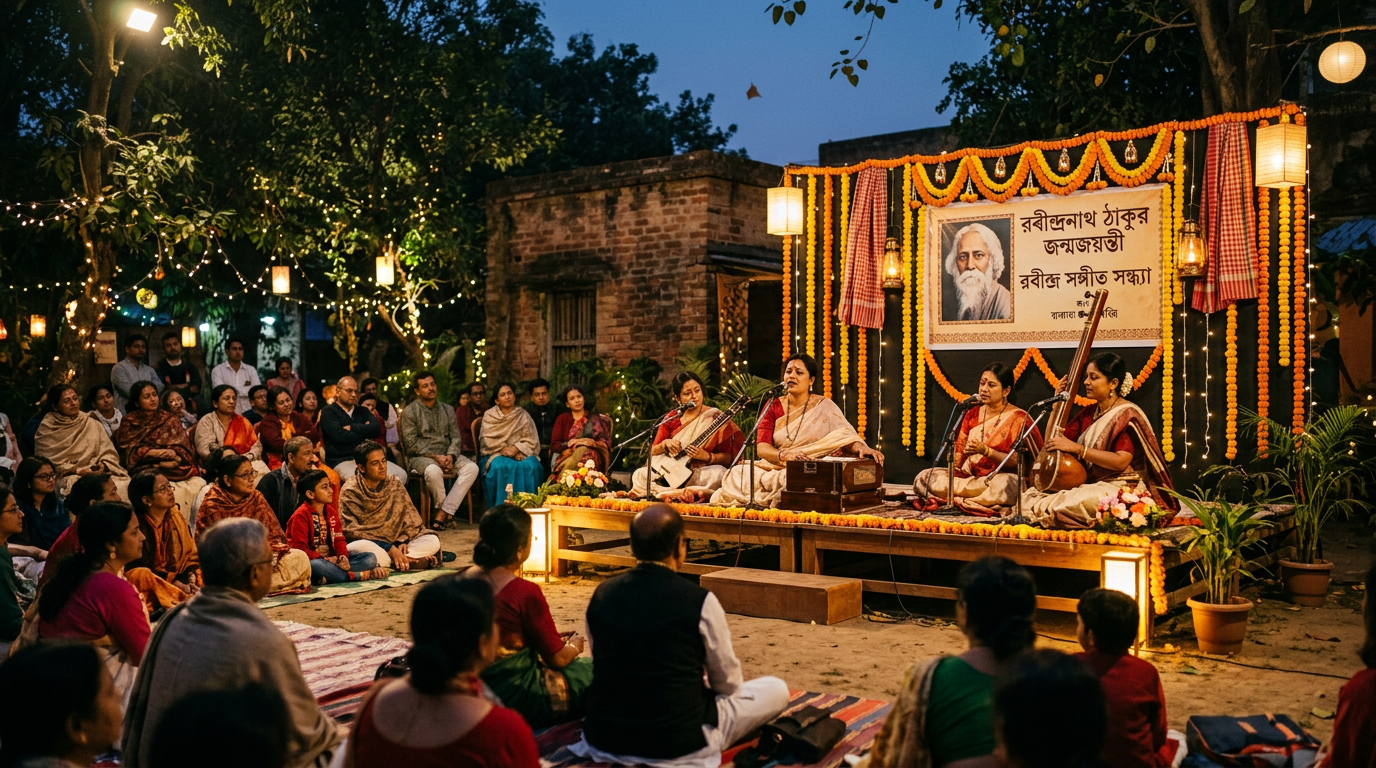
Rabindra Jayanti — the birth anniversary of Rabindranath Tagore on the 25th of Boishakh — is one of the most deeply felt cultural observances in Chittaranjan Park. For CR Park’s Bengali community, Tagore is not merely a historical figure but a living presence: his songs play in homes, his words appear on wedding invitations, and his philosophy shapes community life.
The Celebrations
On May 9, 2026, multiple venues across CR Park come alive with Tagore’s art. Bangiya Samaj hosts the marquee event — an all-day programme of Rabindra Sangeet concerts featuring both established and emerging singers. The repertoire spans Tagore’s vast musical catalogue: Puja (devotional), Prem (love), Prakriti (nature), and Swadesh (patriotic) songs.
Poetry, Drama, and Art
Beyond music, Rabindra Jayanti is a day for the spoken and visual arts. Community halls host poetry recitations where residents — from schoolchildren to retirees — read from Tagore’s Gitanjali, Sanchayita, and other collections. Theatre groups stage short plays or dramatic readings from Tagore’s stories and plays such as Raktakarabi and Dakghar. A children’s art exhibition, usually held at Bangiya Samaj, invites young artists to illustrate scenes from Tagore’s works.
Why It Matters
For CR Park’s residents, many of whom are second- and third-generation migrants from Bengal, Rabindra Jayanti is an anchor to cultural identity. It is a day when the colony collectively reaffirms its connection to Bengali literature, music, and thought — making it one of the most emotionally significant events on the annual calendar.
The five parjay of Rabindra Sangeet
Tagore’s songs — well over two thousand of them — are conventionally grouped into parjay, thematic divisions that concert programmes still use to structure an evening. Knowing the categories makes a recital far easier to follow.
| Parjay | Subject |
|---|---|
| Puja | Devotional; addressed to an unnamed, formless divine |
| Prem | Love, in both its human and its metaphysical registers |
| Prakriti | Nature, subdivided by season — the monsoon and spring cycles are the largest |
| Swadesh | Country and patriotism |
| Anushthanik | Occasional songs written for ceremonies and observances |
| Bichitra | The miscellany that does not fit the others |
A typical Rabindra Jayanti programme moves through several of these, often opening with a Puja song and closing with something from Prakriti. Performers sing from the Gitabitan, the collected edition of the lyrics, and the melodies are expected to be rendered as written — Rabindra Sangeet is performed with notably less improvisational latitude than most Indian vocal forms.
Beyond the songs
Tagore’s output ran across almost every form. The Gitanjali, in the English translation he prepared himself, brought him the Nobel Prize in Literature in 1913. His plays — Dakghar, Raktakarabi, Chitrangada — are staged in abbreviated form at community programmes. His short stories are the backbone of Bengali school syllabi. He painted seriously only in his final years. And he founded Visva-Bharati at Santiniketan, the institution whose Basanta Utsav tradition CR Park’s own Dol Yatra celebration follows.
For CR Park’s residents this breadth is the point. The day is not a music festival with a literary appendix; it is a full cultural observance in which a schoolchild reciting a poem occupies the same programme as a trained vocalist.
Why the 25th of Boishakh
The anniversary is observed on Panchishe Boishakh — the twenty-fifth day of the Bengali month of Boishakh — rather than on a fixed Gregorian date. Because the Bengali months are solar, the date holds close to early May but does not sit on the same day of that month each year. Bengali institutions use the Bengali date and calculate the Gregorian equivalent, which is why published dates for Rabindra Jayanti move by a day or two between years. The Bengali calendar guide sets out how the months are reckoned.
Practical Tips
- The main programme at Bangiya Samaj starts around 10 AM and runs through the evening
- Evening sessions (after 5 PM) tend to feature the most acclaimed performers
- Seating is limited — arrive early or bring a mat for open-air venues
- May heat — carry water and dress lightly; indoor venues are air-conditioned
Frequently Asked Questions
What is Rabindra Jayanti and when is it in 2026?
Rabindra Jayanti is the birth anniversary of Rabindranath Tagore, India's first Nobel laureate. In 2026 it falls on May 9 (25th Boishakh in the Bengali calendar). It is one of the most important non-religious cultural events in CR Park.
Are Rabindra Jayanti events open to non-Bengalis?
Absolutely. All events are free and open to everyone. Many performances include Hindi translations or explanations. Tagore's work transcends language, and all communities are warmly welcome.
What kind of performances can I expect?
Expect Rabindra Sangeet (Tagore songs), Rabindra Nritya (dance choreographed to Tagore's music), recitations of his poetry, staged readings of his short stories, and occasionally a full one-act play from his repertoire.