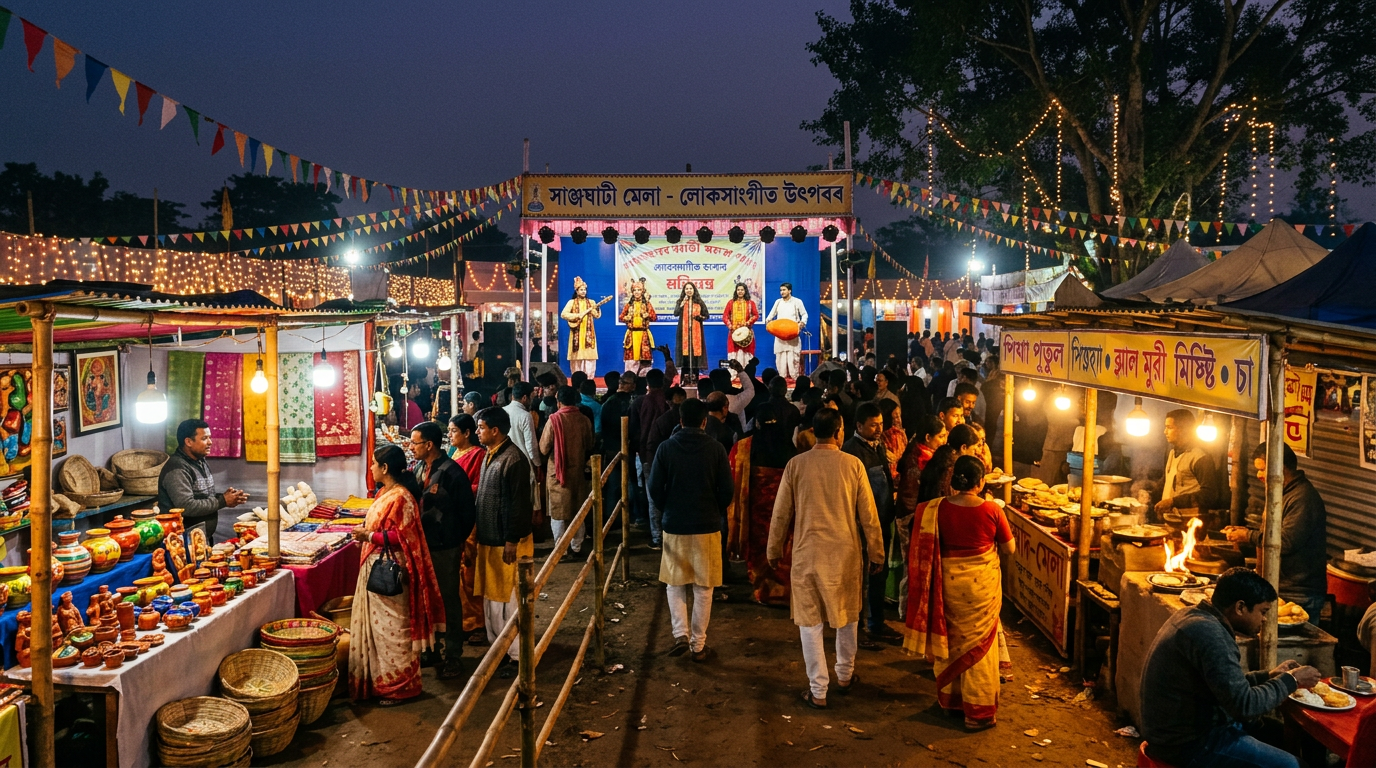
Poush Mela is Chittaranjan Park’s most beloved cultural gathering after Durga Puja, and the 2026 edition marks a milestone — fifty-one unbroken years of celebrating Bengali art, food, and community spirit in the heart of South Delhi. Organized by Bangiya Samaj, the fair transforms the Mela Ground into a vibrant rural-Bengal-in-the-city experience every January.
What to Expect
The three-day fair is built around handicrafts, performance arts, and food. Artisans from West Bengal and neighbouring states set up stalls selling Kantha embroidery, Dokra metalwork, Shantiniketan leather goods, terracotta pottery, and handloom sarees. Live stages host Baul singers, folk theatre excerpts (Jatra), Rabindra Sangeet recitals, and stand-up comedy in Bengali and Hindi.
Fashion Show & Children’s Drama
One of the headline attractions is the Bengali designer fashion show held on the evening of the second day, showcasing handloom and boutique creations. A dedicated children’s drama competition runs on the first morning, encouraging kids from CR Park’s resident families to perform short plays in Bengali. Art workshops — block printing, alpona design, and clay modelling — keep younger visitors busy throughout the weekend.
Food
The food court is reason enough to attend. January is pitha season, and the stalls serve Patishapta, Gokul Pitha, Roshogolla, Nolen Gur Sandesh, and hot Khichuri with Begun Bhaja. Expect queues at the popular stalls, especially on Saturday evening.
Why January is pitha season
Poush is the Bengali winter month, and the fair takes its name from it. The timing is not arbitrary: the two things that define Bengali winter eating are only available now.
The first is nolen gur — date-palm jaggery, tapped as sap from the tree in the cold months, boiled down, and sold either as a thick liquid or set into cakes called patali. Its season is short and its flavour does not survive being made at any other time of year, which is why sweet shops advertise nolen gur sandesh and nolen gur rosogolla as a winter-only line. The Bengali sweets guide covers where the seasonal stock turns up in the colony.
The second is pithe — the family of rice-flour cakes and dumplings made around Poush Sankranti, the harvest festival that closes the month. Pithe are labour-intensive, made from freshly harvested rice, and traditionally cooked at home over several days rather than bought.
| Pithe | What it is |
|---|---|
| Patishapta | A thin rice-flour crepe rolled around a coconut or kheer filling |
| Puli pithe | Stuffed dumplings, either steamed or simmered in sweetened milk |
| Bhapa pithe | Steamed rice-flour cake with jaggery and coconut in the centre |
| Gokul pithe | A stuffed patty, deep-fried and then soaked in syrup |
| Chitoi pithe | A plain, spongy griddle cake, eaten dipped in nolen gur |
What the crafts actually are
The stalls at a Bengali mela sell a fairly consistent set of regional crafts, and knowing what they are makes the browsing better.
- Kantha — running-stitch embroidery, historically worked on layered old sarees to make quilts, now applied to stoles, sarees and cushion covers
- Dokra — non-ferrous metal casting by the lost-wax method, producing figures with a characteristic ribbed, thread-wound surface
- Terracotta — fired clay panels, horses and plaques in the Bankura tradition
- Shantiniketan leather — tooled and dyed leather bags and accessories associated with the craft workshops around Visva-Bharati
- Taant and jamdani — handloom cotton sarees, the latter with supplementary-weft motifs worked in on the loom rather than printed
Buying sensibly
Handloom and handicraft pricing at a mela is not standardised, and quality varies widely between stalls selling apparently identical goods. Look at the reverse side of an embroidered piece, which shows the stitch work honestly; check the weave density of a cotton saree by holding it to the light; and ask a metalworker whether a piece is cast or moulded. Nothing here needs haggling to the point of rudeness, but the first price quoted at a craft stall is rarely the last.
Practical Tips
- Evenings are busiest — visit on Friday morning for a relaxed experience
- Carry cash — most artisan stalls don’t accept UPI or cards
- Nearest metro — Nehru Enclave (Magenta Line), about 1.1 km walk
- Parking — extremely limited; auto-rickshaws from the metro station are the best option
- Photography — performers and artisans are generally happy to be photographed; ask before taking close-ups
Frequently Asked Questions
What is Poush Mela and when does it happen?
Poush Mela is CR Park's annual Bengali cultural fair, held every January. The 2026 edition runs from January 9 to 11. It is the biggest CR Park cultural event after Durga Puja, organized by Bangiya Samaj since 1972.
Is entry to Poush Mela free?
Entry is free for all visitors. Some workshops and the fashion show may require advance registration through the Bangiya Samaj office. Food and handicraft purchases are paid separately.
What should I bring or wear to Poush Mela?
Dress warmly — January evenings in Delhi are cold (5-10°C). Carry cash for handicraft and food stalls. Comfortable footwear is recommended as the mela ground can be dusty.