
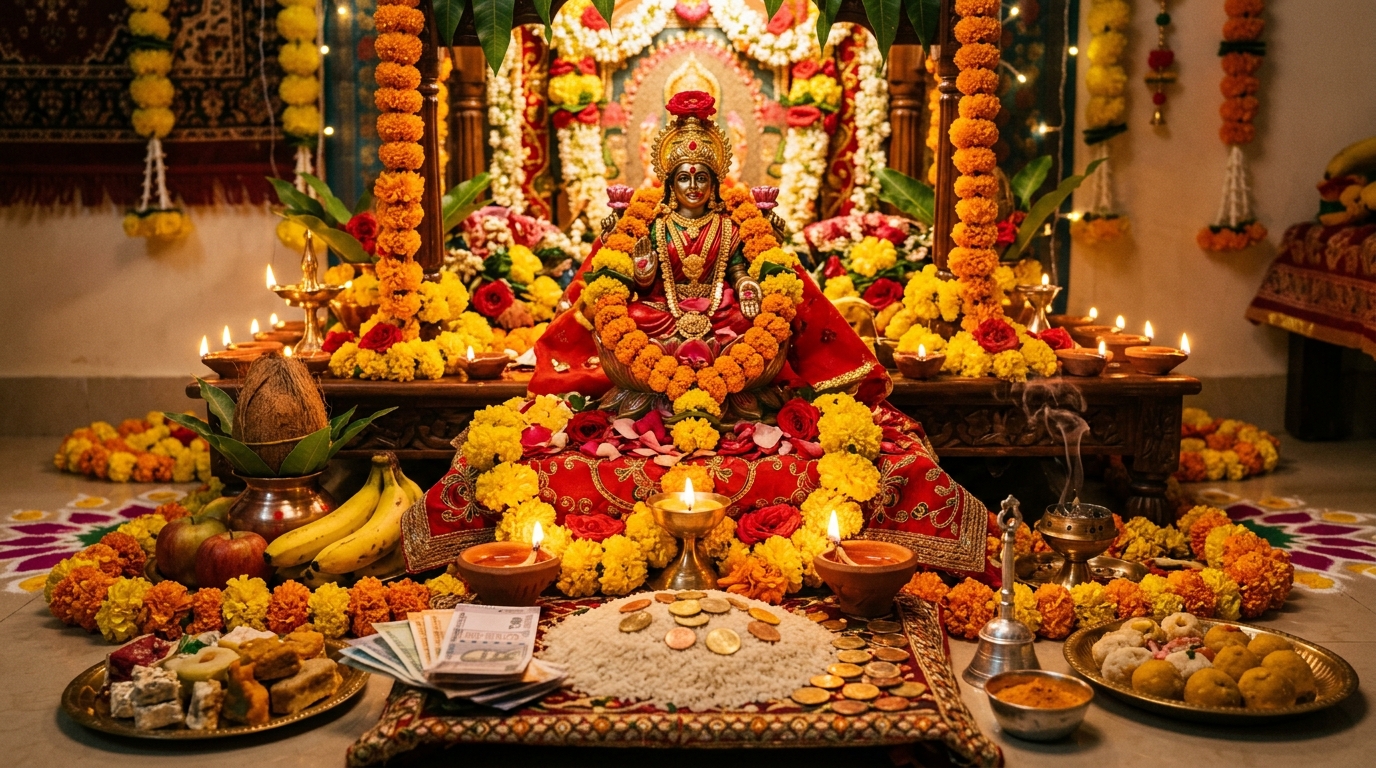
Kojagori Lakshmi Puja is one of Chittaranjan Park’s quieter but deeply cherished festivals. Falling on the full moon night of Ashwin (October 25, 2026), it is primarily a household celebration — families worship Goddess Lakshmi through the night, seeking blessings for wealth, prosperity, and well-being in the year ahead.
The Tradition
The word “Kojagori” derives from the Sanskrit “Ko Jagorti” — “Who is awake?” According to tradition, Goddess Lakshmi descends to earth on this full moon night and blesses those she finds awake and engaged in worship. This belief gives rise to the Jagran (midnight vigil), where families stay up through the night with lamps lit and prayers offered.
At Home
The most striking visual element of Kojagori is the alpona — intricate floor designs drawn with rice paste at home entrances and around the puja space. Women of the household create these beautiful patterns of lotus flowers, fish, footprints, and geometric motifs. The puja thali typically includes dhan (unhusked rice), flattened rice, fruits, and sweets. Homes are cleaned thoroughly in the days before, and oil lamps (pradeep) are kept burning through the night.
At Kali Mandir
Kali Mandir holds a community Lakshmi Puja in the evening, with the main rituals around midnight. Devotees gather for pushpanjali and arati. The full moon over the temple compound, combined with the oil lamps and flower decorations, creates a serene atmosphere.
How to read an alpona
The alpona drawn at a Kojagori Lakshmi Puja is not decoration for its own sake — every motif is doing something. It is drawn freehand with pituli, a paste of ground rice and water, applied with the fingers or a cloth wick onto a swept floor, and it is meant to be walked over and worn away rather than preserved.
- Lotus — the seat of the goddess, usually the central figure of the design
- Footprints — Lakshmi’s own, always drawn pointing into the house, never out
- Paddy sheaves and granary motifs — the wealth being asked for is agricultural in origin, not monetary
- Owl — the goddess’s vehicle in Bengali iconography, distinct from the elephant or lotus-throne imagery used elsewhere
- Fish and conch — auspicious signs carried across from wedding and festival alpona
The work is traditionally done by the women of the household, often with children helping at the edges, and it is finished before the evening puja begins.
The ghot, the panchali and the vigil
Bengali Lakshmi Puja is performed around a ghot — an earthen or brass pot filled with water, topped with mango leaves and a green coconut, and marked with vermilion. It stands in for the deity in households that do not keep an idol, and it is set on a bed of unhusked paddy.
The reading of the Lakshmi Panchali, a verse narrative of the goddess recited aloud by the household, is the core of the home observance. Everyone present listens; the recitation is followed by the distribution of prasad. This is also the point at which the Jagran begins in households that keep it — the lamps stay lit, and the family stays awake, because the premise of Kojagori is that the goddess is out looking for who is still up.
What is cooked
The offering is niramish, without onion or garlic. The characteristic items are narkel naru — coconut and jaggery rolled into small balls — along with moa, puffed rice bound with jaggery, seasonal fruit, and khichuri with labra where a full bhog is cooked. Payesh closes the meal. Winter’s date-palm jaggery has not arrived yet in mid-October, so the naru made for this puja generally uses cane jaggery or sugar.
Sweet shops in the colony sell boxed sets for the occasion, which is the usual way a neighbour’s household is acknowledged if you are not attending the puja itself.
Practical Tips
- This is largely a home-based festival — if you are invited to a Bengali household’s Lakshmi Puja, it is a special privilege
- The Kali Mandir puja is open to all and typically runs from 7 PM through midnight
- October evenings are pleasant — the post-monsoon full moon night is usually clear and comfortable
- Sweet shops stock special Lakshmi Puja boxes; consider gifting one to Bengali neighbours
Frequently Asked Questions
What is Kojagori Lakshmi Puja?
Kojagori Lakshmi Puja is a Bengali tradition of worshipping Goddess Lakshmi on the full moon night of the month of Ashwin. 'Kojagori' comes from 'Ko Jagorti' (who is awake?), as Lakshmi is believed to visit and bless those who stay awake through the night.
When is Lakshmi Puja 2026 in CR Park?
Lakshmi Puja 2026 falls on Sunday, October 25, the full moon night of Ashwin. The puja at Kali Mandir typically begins in the evening around 7:00 PM, with the main rituals at midnight.
How is this different from the Lakshmi Puja during Diwali?
Kojagori Lakshmi Puja is distinct from the North Indian Diwali Lakshmi Puja. It falls on Ashwin Purnima (full moon), usually a few weeks before Diwali. The Bengali tradition emphasises an overnight vigil and alpona floor art, and is often more intimate, centred on homes and the local temple.