
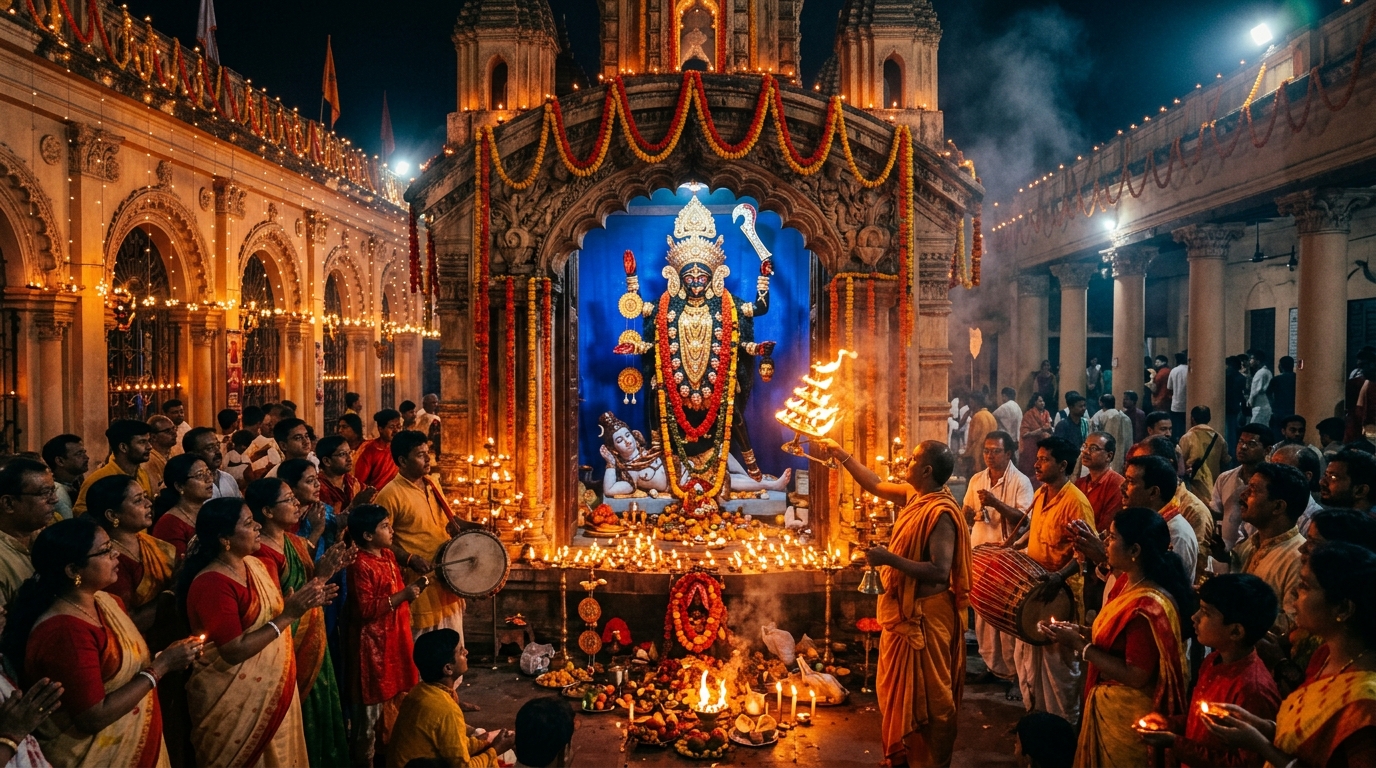
Kali Puja is Chittaranjan Park’s second most important festival after Durga Puja, and on November 8, 2026, the colony will once again transform for a night of intense devotion, spectacular lighting, and community celebration. Falling on the same Amavasya (new moon) night as Diwali, Kali Puja gives CR Park its unique dual identity — Bengali devotion to the Dark Goddess alongside the pan-Indian festival of lights.
Kali Mandir — The Heart of the Night
The Chittaranjan Park Kali Mandir, the colony’s spiritual anchor, becomes the epicentre of celebrations. The temple is elaborately decorated with flowers, lights, and traditional motifs in the days leading up to the puja. On the night itself, thousands of devotees queue for darshan and pushpanjali. The main rituals take place during Amavasya Tithi (approximately 11:30 PM to 12:13 AM), when the priests perform the tantric puja with offerings of hibiscus flowers, sweets, and in traditional practice, symbolic offerings representing the fierce aspect of the Goddess.
Block-Level Pandals
Beyond Kali Mandir, several blocks across CR Park commission their own Kali idols and set up pandals. These neighbourhood celebrations feature impressive lighting — LEDs, neon, and traditional oil lamps — turning the colony’s lanes into corridors of light on the darkest night of the month. Each pandal has its own puja schedule and cultural programme, and residents do a walkabout visiting each one, much like the Durga Puja pandal-hopping tradition.
Diwali Meets Kali Puja
CR Park’s unique character is on full display this night. While Bengali households perform Kali Puja, non-Bengali residents celebrate Diwali with diyas, rangoli, and Lakshmi Puja. The result is a colony ablaze with lights, firecrackers, and overlapping celebrations — arguably CR Park’s most visually dramatic night of the year.
The goddess Bengal worships
The Kali of Bengali practice is usually the Dakshina Kali form — dark-skinned, four-armed, standing with one foot on the prone figure of Shiva, tongue out, a garland of severed heads at the neck and a lowered right hand held in the gesture of granting fearlessness. The iconography reads as terrifying and is not meant to. In Bengali devotion Kali is addressed overwhelmingly as Ma — mother — and the fierce imagery is understood as the form that destroys what harms her children.
The offerings follow the same logic. Jaba — red hibiscus — is the flower of the goddess and is heaped in front of the idol; the colour is the point. Sweets, fruit and rice are offered, and in temples that keep the older tantric form the ritual includes elements that are not part of a household puja.
Why the rituals run past midnight
Kali Puja is fixed to amavasya, the new moon of the month of Kartik, and the main worship is performed in the nishi — the deep night hours. This is not scheduling convenience. The tithi is the ritual requirement, and its start and end times are read from the almanac, which is why puja timings are announced to the minute rather than as a round hour. The Bengali calendar guide explains how those windows are calculated.
Shyama Sangeet
The music of the night is Shyama Sangeet — Bengali devotional songs addressed to Kali, sung in a register somewhere between prayer and argument. The tradition runs back to eighteenth-century poet-composers whose lyrics address the goddess directly, sometimes reproachfully, as a mother who has not been listening. The songs are performed live at pandals and play from loudspeakers between rituals, and they give the Bengali observance a completely different sound from the Diwali celebration happening on the same streets.
| Kali Puja | Diwali, as observed alongside | |
|---|---|---|
| Deity | Kali | Lakshmi and Ganesha |
| Timing | Midnight, on the amavasya tithi | Evening, same new moon night |
| Light | Oil lamps and pandal illumination | Diyas, candles, rangoli at thresholds |
| Sound | Shyama Sangeet, conch, dhak | Firecrackers, family prayer at home |
| Food | Niramish bhog, khichuri, sweets | Mithai boxes, savoury snacks |
The morning after
The idols are immersed the following day in a procession known as bhashan. Block committees dismantle their pandals over the days that follow, and the colony returns to normal quickly — Kali Puja is one intense night rather than the five-day residency of Durga Puja, and its aftermath is correspondingly brief.
Practical Tips
- Reach Kali Mandir by 9 PM to secure a reasonable spot for the midnight puja
- Block pandals are best visited between 8 PM and 11 PM before the crowds peak
- Expect heavy noise from firecrackers; carry ear protection for children and pets
- Traffic — the colony is effectively closed to vehicles after 7 PM; walk or take the metro
- November nights are cool — carry a light jacket
Frequently Asked Questions
When is Kali Puja 2026 and does it coincide with Diwali?
Kali Puja 2026 falls on November 8, coinciding with Diwali. While North India celebrates Diwali with Lakshmi Puja, Bengali communities worship Goddess Kali on the same Amavasya (new moon) night. CR Park uniquely celebrates both traditions.
What time is the midnight Kali Puja at Kali Mandir?
The main puja at Kali Mandir is conducted during Amavasya Tithi, approximately 11:30 PM to 12:13 AM. The temple remains active from the evening, with bhajan and arati building up to the midnight rituals.
Are there pandals for Kali Puja like during Durga Puja?
Yes, several blocks in CR Park set up their own Kali Puja pandals with commissioned Kali idols. These are smaller than the Durga Puja pandals but feature impressive lighting and decoration. The idols are immersed the following day.