
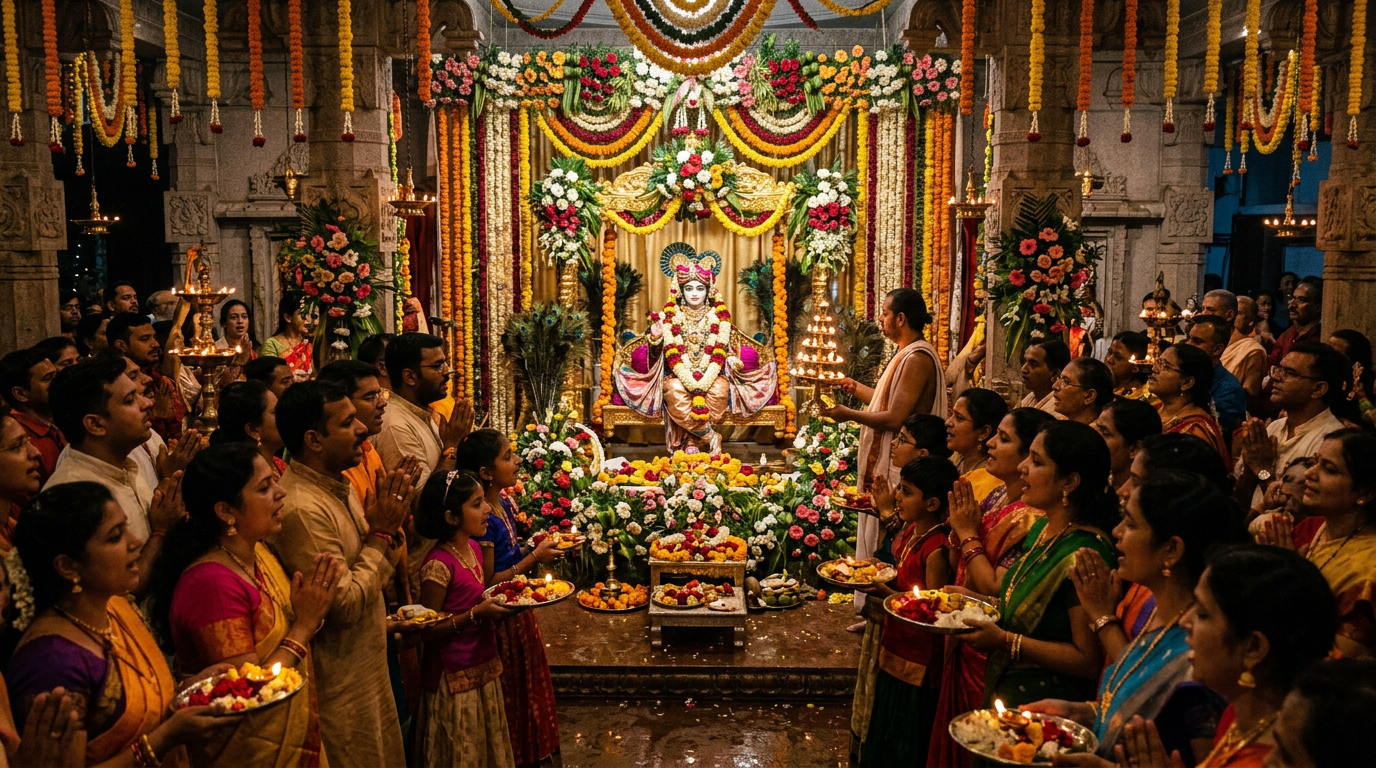
Janmashtami — the birthday of Lord Krishna — is one of the most anticipated devotional nights at CR Park’s Radha Krishna temple within the Kali Mandir complex. The 2026 celebration falls on September 4, with the main puja taking place around midnight.
The Celebration
The Radha Krishna temple is elaborately decorated days in advance, with the idol of baby Krishna dressed in new clothes and placed on a decorated jhula (swing). Devotees visit through the day to offer prayers and swing the jhula. Many observe a strict fast from sunrise, sustaining themselves on fruits and milk until the midnight hour.
Evening and Midnight Puja
The evening programme begins around 7:00 PM with bhajan and kirtan sessions. Singers perform devotional songs recounting Krishna’s childhood exploits — the butter-stealing, the playful mischief, the divine revelations. The energy builds through the night until Nishita Kaal (approximately 11:57 PM to 12:43 AM), when the main puja is conducted. Conch shells blow, bells ring, and the temple erupts in joyous chanting as the birth moment is marked.
Feasting After Midnight
After the puja, fasting devotees break their fast with prasad. The temple distributes panjiri, makhana, fruits, and sweets. Many families head home to prepare a full midnight meal — a rare and festive inversion of daily routine.
Nishita Kaal, and why it has to be midnight
The main puja is not held at midnight for atmosphere. Nishita Kaal is the segment of the night in which Krishna is held to have been born, calculated from the almanac for a specific location, and the window is narrow — typically well under an hour. Everything before it is preparation and everything after it is celebration, which is why the evening programme can start at seven and the actual ritual moment arrive five hours later.
The day itself is fixed to the ashtami tithi of the dark fortnight of the month of Bhadro, which is why the Gregorian date moves each year. The Bengali calendar guide explains the tithi system that produces those shifting dates.
Krishna in Bengali devotion
Bengali Krishna worship runs through Gaudiya Vaishnavism, the devotional tradition shaped in the sixteenth century by Chaitanya Mahaprabhu. Its emphasis is distinctive: the focus falls on Krishna as a child and as the young cowherd of Vrindavan, and above all on his relationship with Radha, who in this tradition is not a secondary figure but the centre of the devotional stance.
Two consequences follow that a visitor will notice. First, the temple is a Radha Krishna temple rather than a Krishna temple — the pairing is the point. Second, the music is kirtan and the older padavali kirtan repertoire, sung narrative verse in Bengali and Brajabuli rather than the Hindi bhajan style more common elsewhere in Delhi.
It is also worth knowing what is not part of the Bengali observance. The dahi handi pot-breaking associated with Janmashtami in Maharashtra and parts of North India is not a Bengali custom, and you will not see it here.
What is eaten
Those keeping the fast eat phalahari food — fruit, milk, and preparations made without grain — until the midnight puja. The fast is broken with prasad.
The dish that marks the date in Bengali kitchens is taler bora: fritters made from the pulp of the ripe palmyra fruit mixed with rice flour and jaggery and deep-fried. The fruit ripens in Bhadro, so the timing is seasonal rather than symbolic. Makhan-misri — butter and rock sugar, the food Krishna is said to have stolen — is offered at the altar, and panjiri, a sweetened flour preparation, and makhana are distributed alongside fruit.
Attending with a family
The temple programme is designed to be attended in stages rather than all at once. Families with small children usually come for the evening kirtan, go home, and return before midnight; older relatives often stay throughout. Nothing about the observance requires fasting, and there is no expectation that a visitor do so.
Practical Tips
- Arrive by 10 PM to get a comfortable spot near the sanctum for the midnight puja
- The temple gets crowded between 11 PM and 1 AM — be patient with queues
- September weather — warm and possibly humid; dress in light cotton
- Parking — limited after dark; walk or take an auto from Nehru Enclave metro
Frequently Asked Questions
What time is the Janmashtami midnight puja in CR Park?
The main puja takes place during Nishita Kaal, approximately 11:57 PM on September 4 to 12:43 AM on September 5, 2026, at the Radha Krishna temple in the Kali Mandir complex.
Do I need to fast for Janmashtami?
Fasting is traditional but entirely voluntary. Many devotees observe a nirjala (waterless) or phalahari (fruit-only) fast from sunrise until the midnight puja. The fast is broken with prasad after the puja concludes.
Are children welcome at the midnight celebration?
Yes, families with children are welcome. The evening cultural programme begins around 7 PM, and many families attend with children for the earlier events before staying on for the midnight puja.